
Interior vs. Exterior Paint: Why You Can't Swap Them
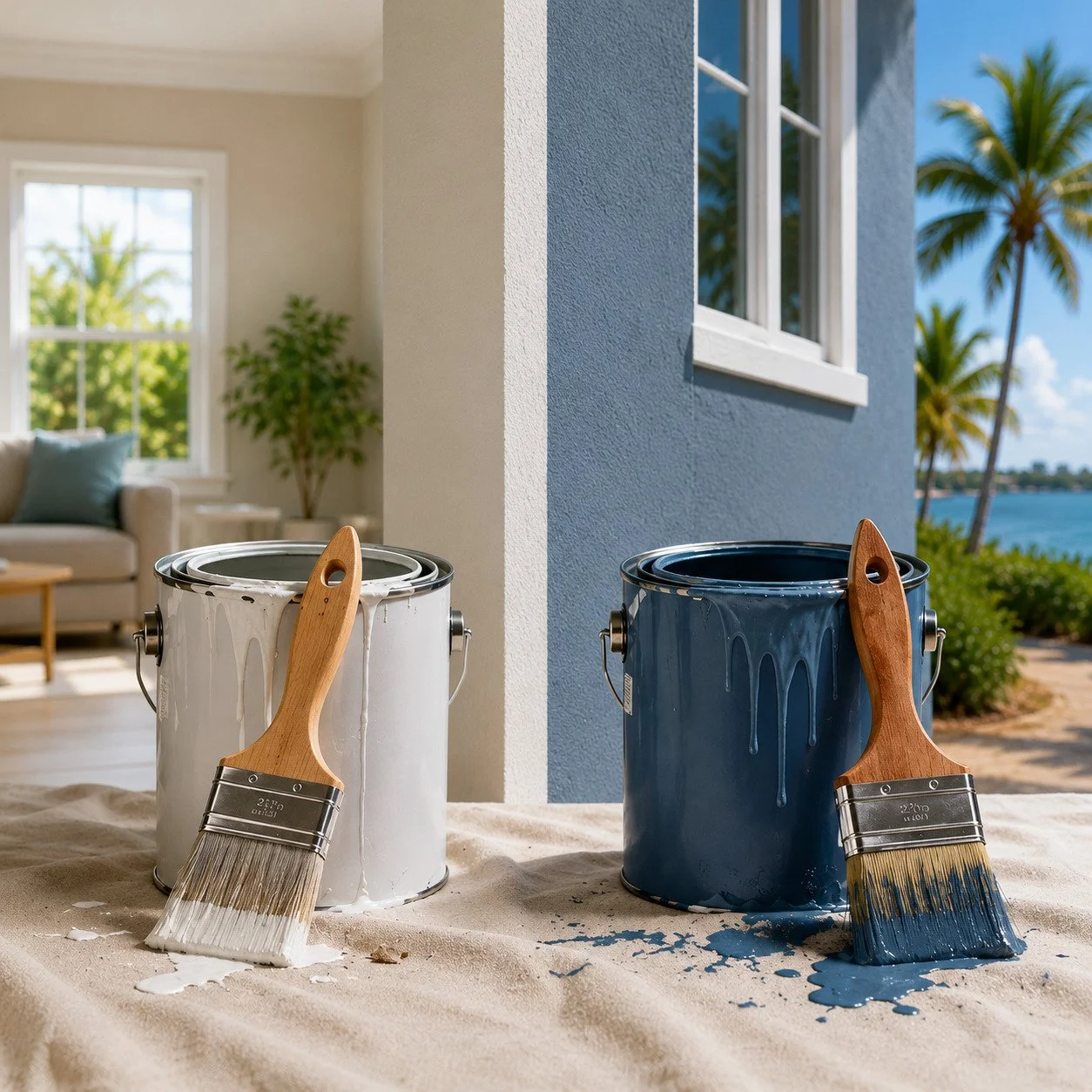
Quick Answer: Interior and exterior paints are formulated for different environments. Exterior paint uses flexible resins and additives for UV resistance, water repellency, and mildew resistance, so it survives sun, rain, heat, and humidity — critical in Miami. Interior paint is built for a smooth, washable, scrub-resistant finish with low odor and low VOCs, since it lives in stable, enclosed spaces. You can't safely swap them: exterior paint indoors adds unnecessary fumes and won't give a washable finish, and interior paint outdoors fails fast against Miami's sun and humidity. Use each where it belongs.
It looks like paint is paint — but interior and exterior paints are engineered very differently, right down to their ingredients, because they face completely different conditions. Use one where the other belongs, and you get a poor result, or indoors, fumes you didn't need. In a climate like Miami's, where exterior paint goes up against brutal sun and humidity, the differences matter even more. Here's what really separates the two and why each has its place.
Built for Two Different Worlds
Both paints color and protect a surface, but the worlds they live in couldn't be more different. Exterior paint must survive everything outdoors throws at it — in Miami, that means intense UV, heat, heavy rain, and constant humidity. Interior paint lives in a climate-controlled, enclosed space, where instead it has to look smooth up close, clean up easily, stand up to scrubbing, and keep the indoor air pleasant. Those opposite demands lead to different formulas: different resins and additives engineered for each environment. The differences aren't marketing — they're real chemistry built for the job, and that's why you can't swap the two.
What Sets Exterior Paint Apart
Exterior paint is built to withstand the weather. It uses flexible resins that let it expand and contract with the heat without cracking, which matters under Miami's steady warmth. And it's loaded with additives to fight the outdoors: UV-resistant pigments to hold off the sun's fading, water repellency to shed rain and handle humidity, and mildew resistance to fight the mold and mildew that Miami's damp air encourages. Those let exterior paint keep its color and protect the surface through conditions that would chew through interior paint in no time. In a high-UV, high-humidity climate, those weather-fighting properties are exactly what an exterior coating needs.
What Sets Interior Paint Apart
Interior paint is built for living spaces. It's made to go on smoothly, cover evenly, and give a clean finish you see up close every day, and to be washable and scrub-resistant so you can wipe off marks and scuffs without harming it. Because it takes place in enclosed spaces, it's also designed for lower odor and emissions, with many products being low- or zero-VOC to improve indoor air quality. It skips the weather-fighting additives it doesn't need and tunes itself instead for appearance, cleanability, and a comfortable indoor environment.
| Feature | Exterior Paint | Interior Paint |
|---|---|---|
| Built to handle | Sun, rain, heat, humidity | Stable indoor conditions |
| Resins | Flexible, weather-durable | Optimized for smooth finish |
| Key additives | UV resistance, water repellency, mildew resistance | Washability, scrub resistance |
| Air quality | Less of a concern (open air) | Low odor, low/zero VOC |
| Optimized for | Weather durability | Appearance and cleanability |
Why You Can't Just Swap Them
Each paint causes trouble in the wrong place. Exterior paint indoors is the bigger concern: it can carry additives and release more fumes and VOCs than belong in an enclosed space, raising indoor air-quality issues, and it won't give the smooth, washable finish interior walls need. Interior paint outdoors fails the other way — it lacks the UV, water, and mildew resistance to survive, so under Miami's sun and humidity, it fades, cracks, peels, and grows mildew very quickly. Either mismatch wastes both the paint and the labor, because you'll redo it correctly anyway. The tricky part is that the wrong paint can look fine for a few weeks, so the mistake often isn't obvious until the finish starts to fail — peeling and chalking outdoors, or never quite wiping clean indoors. By then, the only real fix is to strip it back and repaint with the right product, which costs far more than buying the correct paint would have. Matching paint to its environment the first time spares you that double cost and gives you the finish and durability each one is built for.
Don't use leftover exterior paint on interior walls to use it up — the extra fumes aren't worth it indoors and you won't get a washable finish. And never put interior paint outside in Miami; the sun and humidity will ruin it within a season. Each paint belongs where it was made to be used.
Frequently Asked Questions
It's not advisable. Exterior paints are formulated with additives and chemistry for the outdoors and can release more fumes and VOCs than is appropriate for an enclosed space, raising indoor air-quality concerns, and they won't give the smooth, washable finish interior walls need. For indoor projects, a proper interior paint — ideally low- or zero-VOC — is both safer and better-performing. Using exterior paint inside trades a good indoor finish and air quality for no real benefit.
It fails quickly. Interior paint lacks the UV resistance, water repellency, and mildew resistance that exterior paint relies on, so under Miami's intense sun, heat, and humidity it fades, cracks, peels, and grows mildew fast — often within a single season. It simply isn't built to be outside, and Miami's climate is especially harsh on it. Using interior paint outdoors here wastes the paint and the effort, since it won't hold up and will need redoing with proper exterior paint.
Because it's formulated with additives specifically for those threats. Exterior paint contains UV-resistant pigments to resist fading and mildew-resistant additives to combat the mold and mildew that damp climates like Miami's encourage, along with water repellency to handle rain and humidity. These additives let it hold color and protect the surface outdoors. Interior paint doesn't include them because it doesn't face weather, which is part of why interior paint fails outside, and exterior paint is suited to it.
Yes. Interior paint is formulated for use in enclosed spaces, so it's generally made for lower odor and lower emissions, with many options being low- or zero-VOC for better indoor air quality. That makes it the appropriate choice for living spaces where you're breathing the air. Exterior paint isn't designed around indoor air quality since it's applied outdoors, which is a key reason it shouldn't be used inside. For any indoor project, a quality low-VOC interior paint is the right call.
It does. Interior and exterior paints are engineered with different resins and additives for completely different environments, and using the wrong one leads to poor durability, a poor finish, or air-quality concerns. Exterior paint won't provide a washable indoor finish and creates unnecessary indoor fumes; interior paint can't withstand Miami's sun and humidity outdoors. Matching the paint to where it's used delivers the finish, longevity, and indoor air quality each is designed for, which is why the distinction matters.
Use Each Paint Where It Belongs
Interior and exterior paints aren't interchangeable — they're engineered for opposite environments. Exterior paint uses flexible resins and additives for UV, water, and mildew resistance to survive Miami's sun, heat, and humidity, while interior paint is built for a smooth, washable, low-odor finish in stable indoor spaces. Swap them, and you get fast failure outdoors or a fume-heavy, non-washable finish indoors. For an exterior facing Miami's sun and humidity, that means a quality weather-rated paint built to resist UV and mildew; for interior walls, a washable low-VOC one made for clean indoor air. Match each to its place and both perform as intended, looking good and lasting the way the paint was designed to.
Starting an interior or exterior painting project? — Get the right products and a lasting finish from an experienced Miami painting team. Vinicio Painting serves Hialeah Gardens, Miami Lakes, Doral. Call (866) 444-1226.
