
Can a Popcorn Ceiling Be Painted Without It Falling Off?
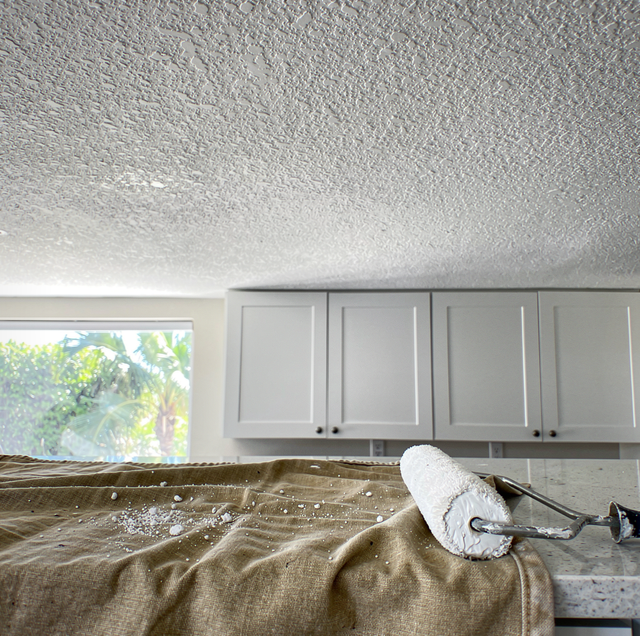
Halfway through the first coat, a fine white grit starts landing on the drop cloth. It is not dust. It is the ceiling itself, coming down a few grains at a time, and by the end of the room there are bare gray patches where the texture used to be. The roller cover is loaded with what came off.
That is not bad luck, and it is not the paint. Popcorn texture is a sprayed-on coating that was never built to be rewetted, and a loaded roller does something to it that a spray gun never did. Once you can picture what happens where the nap meets your ceiling, the odds of your popcorn surviving a fresh coat are no longer a gamble.
What Makes a Popcorn Ceiling Let Go Under a Roller?
Popcorn is not paint and never behaved like paint. It went up as a wet slurry from a hopper gun and dried where it landed, gripping the drywall's paper face. Nothing holds the two together, but that dried contact, and the wet-scrape method shows how little force that bond takes: a light water mist softens the popcorn material so it releases from the drywall paper at a controlled scrape depth.
A roller carries the same two ingredients as that mist, water and pressure, and holds them against the surface for longer. Paint is mostly water; a nap carries much of it, and every square foot of a rolled ceiling gets touched more than once, because the habit is to lay the coat on and then even it out. The first pass wets the peaks. By the time the nap comes back across them, the outer skin of the texture has begun to soften, and the fibers are dragging against grains that have lost part of their grip. A little more pressure on that pass and those grains come away on the cover.
The same motion turned aggressive has its own name: dry-scrape, which pulls harder, tears drywall paper, and broadcasts dust. So the ceilings that survive a repaint are the ones touched fewest times, and that is most of what you can control on your ceiling: a heavy load, one direction, no return trip over wet material, and a second coat only after the first has dried hard instead of a wet second pass over your texture.
The Ceiling's Age Comes Before the Paint Does
None of that matters yet if nobody knows what the texture is made of. Federal guidance on where asbestos may be found in a house lists textured paint and patching compounds used on walls and ceilings, as well as vinyl floor tiles, pipe insulation, and roofing shingles. Older acoustic ceilings sit inside that description, and federal safety regulators date the material: its use was banned in 1977. The people at risk are not holding the roller. They are the household below, breathing that room air all week.
Federal guidance points away from the ceiling: generally, you cannot tell whether a material contains asbestos simply by looking at it unless it is labeled. So if in doubt, treat the material as if it contains asbestos and leave it alone. It adds that material in good condition that will not be disturbed should be left alone. Painting is a refresh that can honor that rule, but only when the coat is applied without abrasion.
Sanding or scraping an untested popcorn ceiling can release asbestos fibers into your family's air, so a trained and accredited asbestos inspector rather than the homeowner comes first.
Testing is an ordinary part of this trade. A small piece of the material is sent to a certified laboratory, which reports the fiber types it contains. Painting contractors who work over old acoustic ceilings arrange that step during the walk-through, before your quote is written and long before a cover is loaded.
A Long Nap Reaches Into the Valleys a Short One Skips
The cover on the frame matters more here than on any wall. Roller nap is the length of the fibers standing off the backing, and on a flat surface a short one leaves the smoothest film. Your ceiling is not a flat surface. It is a field of peaks and hollows, and a short nap bridges the peaks while leaving the hollows dry. Manufacturer guidance on matching a cover to a surface puts the rule in one line: rough surfaces require a higher nap, from three-quarters of an inch to an inch and a half, so the long fibers can reach into the valleys of the texture.
That is a texture-preservation choice as much as a coverage choice. A short cover that misses the hollows sends your painter back over the same ground to fill them, and every extra trip lands on material that is already wet and softening. A long cover reaches the hollows on the first trip and carries more paint per load, so the frame comes off the tray less often and spends less time pressed into your ceiling.
Old Water Stains Need a Primer That Blocks Them
Texture hides history. A roof leak from six years ago, a condensate line that overflowed once, a supply fitting that wept behind a wall: all of it can sit inside popcorn as a brown halo nobody looks at until the room is repainted. Those areas need a specific fix: water-stained drywall under the popcorn needs an oil- or shellac-based primer before the finish coat, since latex primer lets the stain bleed through.
That belongs in an article about texture falling off for one reason. A stain bleeding through a finish coat invites another coat, then a third, each one landing on material wet several times in a week. The primer does two jobs at once: it stops the stain, and by stopping it, it holds the number of trips across your texture down to the two your ceiling can afford.
Why Humid Air Stretches the Wait Between Coats
Dry time undoes a careful job faster than any tool. Where ambient humidity stays above 70 percent for most of the year, joint compound that would dry overnight in a dry climate takes 24 to 48 hours. Ceiling paint is not joint compound, but it answers to the same air, and a film that feels dry to a fingertip can still be soft underneath.
Put a second coat onto a ceiling in that condition, and you have recreated the situation the first coat was rolled carefully to avoid: wet material, a wet nap, and drag. Crews who get this right treat the interval as part of the specification, giving the first coat a full day before the second goes near it.
What a Painted Popcorn Ceiling Actually Buys You
It is worth being honest about the result. The popcorn can stay and simply be painted, but it remains popcorn; painting over existing texture is an option for anyone not ready to scrape, and painted popcorn has the same look as fresh paint. A repaint brightens a yellowed ceiling, buries cooking film, and evens out patch marks. It does not flatten anything, and it is not a step toward flattening anything either.
What it does buy is a clean drop cloth. A ceiling whose age was checked before the work started, whose stains were primed with something that blocks them, and whose coat went on in single passes with a cover long enough to reach the hollows leaves nothing on the floor but spatter. No white grit. No bare gray patches overhead. The popcorn you started the morning with is the popcorn you keep, in fresh paint.
Frequently Asked Questions
Not really, though it changes the water. Paint slows how fast a mist soaks in, so a crew scraping your painted ceiling later wets it longer and works smaller areas at a time. Your ceiling remains removable, and your removal simply requires more patience.
Nothing touches the surface with a sprayer, so the mechanical drag disappears. What remains is the water, which still soaks in and still softens the grains. Spraying an occupied room also means masking every surface in it, so your painter will weigh the two for you before quoting your job.
Longer than a wall, because nothing rubs against a ceiling. The usual reasons for recoating are a new stain, a fixture swap, or yellowing near a kitchen, and none of those run on a schedule you can predict. Your crew can look at your ceiling during any other interior job in the house.
Work stops on that patch. Rolling more paint across bare drywall paper spreads the damage and leaves a shine where your texture used to sit. Your painter fills the void with matching texture, feathers the edge, lets it cure, and paints it in, so you get a repair rather than a scar across the room.
Flat is the default on ceilings for a reason. Flat or matte finishes hide minor surface imperfections and avoid glare under overhead lighting, while eggshell and satin show every roller mark and ceiling-light reflection. On popcorn, a surface made of shadow and highlight, a sheen would print each irregularity across your whole room, so your painter starts there.
No, and federal guidance is quite blunt about why. A trained and accredited asbestos professional should take samples for analysis, since a professional knows what to look for and because there may be an increased health risk if fibers are released. Sampling done incorrectly can be more hazardous than leaving the material alone, so taking samples yourself is not recommended. Your painter can arrange that sampling through a certified laboratory as part of the walk-through, so you never handle the material.
Ask for a ceiling walk-through before any roller touches the texture — a crew that checks age, stains, and adhesion first keeps the popcorn up on the ceiling. Vinicio Painting serves Hialeah Gardens, Miami Lakes, and Doral. Call (866) 444-1226.
