
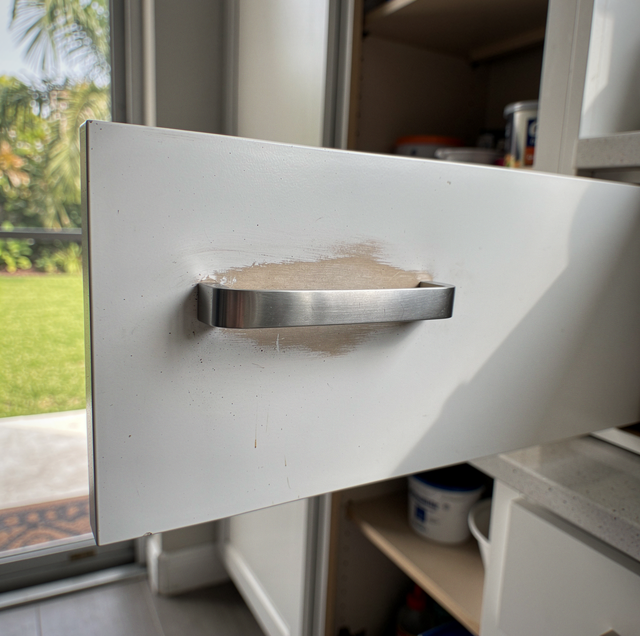
A wall's paint is touched in passing and across a broad surface, except for a few spots, such as the area around a light switch. A cabinet gets touched constantly, and only in a few exact spots: a hand on the pull, a knee against the toe-kick, a rag wiping grease off the door beside the range, water dripping down the panel under the sink. The same coating can hold up on a wall and fail in a handful of small, specific places on a cabinet while the rest of the kitchen still looks sound. That uneven pattern moves the question about a tired cabinet finish away from the paint's age and onto where the coating has failed and how deep that failure runs — into the topcoat only, into the wood or board underneath it, or into the joint where two pieces meet.
The signs a painted cabinet shows each say something of their own about the coating under it, from the surface film down to the wood or board beneath:
| Sign | What It Says About the Coating |
|---|---|
| Finish worn through to bare wood or primer around pulls and door edges | Abrasion has worn through the topcoat at the contact point |
| Chips along the bottom rail and toe-kick | Impact and mop-water contact have broken the film there |
| A film that stays tacky or gummy after cleaning | The coating has been softened by grease or cleaning chemicals |
| Peeling in sheets from one door or the sink base | The coating has lost adhesion to the substrate underneath it |
| Swelling or raised grain at a seam or edge | Moisture has reached bare wood or board at that joint |
| A color or sheen that no longer matches after touch-ups | Small repairs at different times have left a patchwork of coating ages |
Wear-Through at the High-Touch Points
Each grip on a pull or push on a door wears at the coating at that exact spot. A cabinet door gets that contact again and again at the same few places: the pull, the edge nearest the pull, and the bottom corner a knee catches walking past. Enough repetitions of that contact sand the topcoat down to primer, then to bare wood or board, while the rest of the door panel stays fully coated. The result is a distinctive pattern: a worn halo around the hardware and along one edge, with the flat field between them untouched. That pattern is abrasion. It stays confined to the places a hand or a knee reaches, which is why it shows up first at pulls, door edges, and the bottom rail, and can leave the center of a flat panel fully intact. A door with a worn halo around its pull but a solid field everywhere else shows where the coating has thinned at the contact points.
Tacky or Gummy Finishes and Why Cleaning Does Not Fix Them
A film that stays sticky after being wiped down has a problem with the coating itself. Cooking grease and some cleaning products can soften a cured coating from the surface down, taking away the hardness a topcoat depends on. Once that has happened, wiping the surface removes loose dust and film residue, but it cannot restore the coating's hardness. The finish stays soft, and a slightly tacky surface holds dust and grease more readily than a hard one, so the film builds again between cleanings. This shows up on doors near the range or the sink, where grease and cleaning spray land, and can leave a pantry door on the same cleaning schedule with none of the same softening. A gummy film that will not firm back up after a thorough degreasing and a full dry-out has broken down or never fully cured. Cleaning it again removes loose grime, but it does not restore the coating's hardness or stop it from softening further the next time grease or a cleaner touches it. That distinction decides the fix: a coating that has broken down or never cured calls for a new coat.
Peeling and Lost Adhesion
Peeling is a different failure from wear-through, and it shows up differently. Instead of thinning gradually at a contact point, the coating separates from the underlying wood or board in a sheet, starting at an edge or corner and working inward. That kind of failure means the coating's grip on the substrate gave out. Two spots in a kitchen can show it before the rest of the cabinets do: the doors on either side of the range and the dishwasher, where heat and steam from those appliances reach the coating, and the sink base, where splashed and dripping water reach the cabinet directly. Repeated heat or moisture at one spot can break the coating's bond there. Peeling that starts at one door or one cabinet and stays there, rather than spreading across the kitchen, can come from a local source like that rather than from a finish that simply came due. The same coating on a door away from both sources can remain bonded, which is why peeling on one door says more about where that door hangs than about the paint's age.
Swollen Edges and Seams Where Water Reached the Core
Wood and board swell when water gets past the coating and into the material itself, and that swelling shows up first at a seam, a corner, or a door edge, wherever the panel has an exposed edge the coating has to seal. A raised, spongy edge, or a seam that has opened slightly, is a sign that moisture has already reached the core material. [WARNING: A swollen sink base can indicate a leak is still running, and water reaching a disposal plug or outlet in that cabinet is a shock hazard, so a plumber shuts off the supply and repairs the leak before any refinish.] A door or panel with soft, crumbling material at the swollen spot, rather than just raised grain, is beyond what a refinish alone can correct, and that section is replaced instead of recoated.
Touch-Ups Versus a Full Refinish
A touch-up treats one wear spot at a time: sand the damaged area, prime it, and blend in color and sheen to match what is already there. Done well, that keeps a kitchen presentable between full refinishes. Done in enough separate spots, though, it creates a patchwork of mismatched repairs: touch-ups laid down at different times, with slightly different sheens and colors, that stand out under direct light even when each one looks fine on its own. Once wear-through, tackiness, peeling, and swelling appear in more than one spot for different reasons, a full refinish resets the whole set of doors to a single coating age.
A full refinish takes doors and drawer fronts off their boxes, degreases every surface, with windows open and gloves on, since degreasers and strippers give off fumes and irritate skin, sands or scuffs the old finish so the new coating has something to grip, applies a bonding primer over the old finish and any repaired wood, and finishes with an enamel topcoat built to cure into a hard, cleanable surface. [WARNING: Paint layers beneath a cabinet's current finish can contain lead, and sanding or scraping releases lead dust that is inhaled or tracked throughout the house, so testing comes first, and a crew working under containment removes any coating that tests positive.] Handled that way, the new finish starts from one consistent base instead of building on whatever mix of wear, touch-ups, and older coatings was already there.
Frequently Asked Questions
Yes, when their finish shows the same wear or the color is changing. Face frames and end panels stay in place during a refinish and are prepared and coated where they hang, so a kitchen can have its doors redone alone or the whole set brought to one color and sheen.
A cabinet's interior is not always brought to the same coating system as its exterior: some are left as bare or clear-sealed wood, or with laminate shelving, so a refinish plan can leave the interior alone when it was never part of the painted topcoat to begin with.
Pulls and knobs removed before painting can go back on once the new coat has fully cured, but hardware in a different style with different hole spacing may require filling the old holes and drilling new ones, unless the new pieces cover them.
A glass-front door's coating stays confined to the narrow frame around the pane, so wear on that style shows up first along the frame rather than spreading across a broad, flat panel.
Yes. A veneered door carries a thin wood face glued over a particleboard or MDF core, so there is little thickness to sand before the core shows through. A lifted veneer edge can sometimes be glued back down before priming, but where the core under it has swollen, that door is past refinishing.
A true chip breaks through to a lower layer, whether primer, an older color, or bare wood, at the point of impact. A scuff or scratch that only dulls the sheen without breaking through leaves the film whole, so it is cosmetic.
Retain cabinet painting and refinishing — doors off, degreasing, sanding, a bonding primer and an enamel topcoat. Vinicio Painting serves Hialeah Gardens, Miami Lakes, and Doral. Call (866) 444-1226.