
Exterior Trim Needs Repainting First, and What Slows It
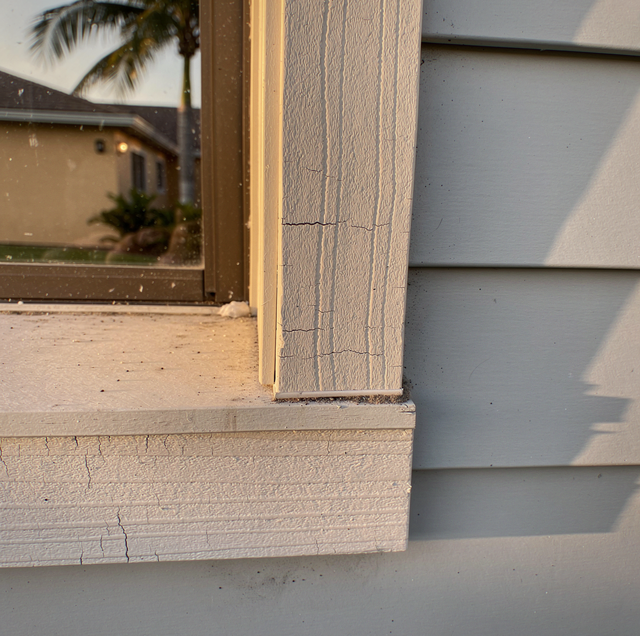
A nominal one-by-four casing leg measures three and a half inches across its face and three-quarters of an inch thick, and the finish coat has to cover both surfaces. The wall behind it got the same product on the same day.
Ten years on, the casing is dull and finely checked while the siding two inches away still looks even. The corner boards have gone the same way. Nothing else on your elevation looks due.
The coating is common to both surfaces, so the difference sits in the board. Trim is a narrow member standing proud of the plane it is fixed to, and that geometry changes what the film has to survive from the day it dries.
The Surface a Trim Board Presents
That three-quarter-inch edge is not a rounding error on the coated area. On a casing leg it adds better than a fifth again to the painted width of the face, and every inch of it stands at a right angle to the face it joins. A corner board doubles that arrangement.
Then count what else on your elevation carries that description. Casings and brickmould sit around every opening, and corner boards stand at each change of plane. Every one of them stands proud of the surface it is fixed to, and every one was coated out of the bucket mixed for the wall.
Siding is a flat field. It runs along courses across a plane and presents a single surface in a single orientation. A square foot of siding is a square foot of face. A square foot of trim is a face, an edge, and the corner where those two meet.
A crew reads that as a schedule. On a repaint walk, the field can look sound while your trim on the same elevation is visibly finished. An elevation does not weather evenly, and your trim shows the unevenness first.
Two Faces at Right Angles Catch More of the Day
A flat wall faces one direction. Direct sun reaches it only when the sun is within 90 degrees of the direction the wall points. Your trim board presents its face in that direction and its edge at a right angle to it, so one surface or the other stays in sun across a wider swing of the sky.
Water arrives on the same terms. Rain running down a wall travels as a sheet across the courses and leaves at the bottom. Where your trim interrupts that plane, the sheet is broken and routed around a member a few inches wide, so water that would have crossed a foot of siding crosses a much smaller area of coating. Wind-driven rain meets the proud edge head on.
The film's clock runs on wetting cycles and on hours of direct sun, and your trim collects more of both per square foot than the surface it is fixed to. Two surfaces under one coating, with one of them taking more of the load, do not come due together.
The Substrate Changes at the Trim Line
Where the field is fiber cement or stucco, and the trim is wood, the substrate changes along that line and the coating does not. Wood pulls water out of the air and gives it back on the air's schedule, so the board under your trim coat is never the same board twice, while a cement board holds its dimension through the same week.
Surface area drives how fast that exchange happens. A narrow member has a great deal of surface area for the amount of wood inside it, so it takes up moisture and releases it faster than a thick or wide one does. The face of your casing responds to a wet night and a dry morning; the framing behind the wall barely registers either.
Engineered and composite trim change the picture in the useful direction. Boards made from resin-bonded wood strands or cellular PVC hold their dimensions far better than the solid stock on your house during the same wetting. They do not remove the geometry, though, and the coating on their edges behaves as the geometry predicts.
Trim Carries the Fasteners and the Hardware
Every trim board on your house is fastened through its own face. A casing leg is nailed off along its length, and each fastening is a hole that is filled before anything is painted over it. The coating on that spot is bonded to filler rather than to wood, and the two do not take up a coat the same way or hold it as long. On the next repaint, the same holes are opened again.
Then there is what gets screwed to it. A door jamb takes hinges and a strike plate, and the casing beside it takes whatever the entry carries, from a closer arm to a light fixture. Each of those is a penetration through the coating, and each is unscrewed and reset the next time your trim is painted, which opens the film around it a second time. None of that hardware lands on the siding, nor do the ladder feet and the string trimmer that your corner boards absorb.
The Film Is Thinnest Where the Board Is Sharpest
Seventy percent is the number that marks a coating as edge retentive, and it comes from a test in a military coatings specification for ship structures: three specimens are cut from a coated ninety-degree angle that has not been chamfered, and the film thickness at the apex is compared against the thickness on the flat.
That ratio has to be measured because a wet coating does not stay where it is put on a sharp corner. A liquid film has surface tension, and surface tension draws a free surface toward the smallest area it can occupy, which means away from a convex apex and onto the flatter ground beside it. A coating also loses volume as the water or the solvent leaves, and the film cures, and that shrinkage pulls the same way. So the dry film on an unbroken arris, the square edge of your casing leg or the outside corner of a piece of brickmould, ends up carrying less thickness than the film on the face two inches away, and a coating that holds less than seventy percent of it there is what that specification calls not edge retentive.
A crew that knows this treats the edge as its own operation. Breaking the arris takes the square corner off before any coating goes on, and a coating standard for thermal spray coatings on steel bridges puts the minimum break at a sixteenth of an inch of chamfer or radius. Those are steel structures, and yours is a wooden board, but a sanding block run down the arris of your casing does the same geometric work, and back-priming reaches what the finish coat never will.
The arris is small enough to take off in one pass with a block and long enough to run the full length of every board on your wall.
Frequently Asked Questions
Finger-jointed stock is short lengths of wood glued end to end, so a single board on your casing run carries glue lines along its length. Each joint places two pieces with different grain orientations and moisture contents side by side under a single film, and the two halves respond to the same wet week differently. The joints telegraph through the coating as fine ridges or hairline splits while the clear stretches between them still look sound.
It buys you a uniform surface to paint onto and a limited amount of time. A mill-applied primer is a holding coat with a stated life: manufacturer installation instructions for engineered trim and siding direct that paint be applied as soon as possible and within 180 days. If your trim has stood longer than that, the primer has weathered, and your painter will wash and spot-prime it before you get a finish coat.
Across the grain, enough to matter. Wood-industry data puts dimensional change across the grain at roughly one percent per four percent change in moisture content, so the three-and-a-half-inch face of your casing gains and loses on the order of a thirty-second of an inch. Along the grain it is negligible: published research gives longitudinal shrinkage from green to oven-dry at 0.1 to 0.2 percent. Your film follows your board's width.
On the stop face, where the weatherstrip is compressed against it every time you shut the door and released every time you open it. The seal maintains contact with the coated surface even when your door is open, because the weatherstrip maintains its compression set. You will see it as a burnished stripe down the jamb, sometimes with the seal's own color transferred onto your paint. Your window casings carry nothing like it.
No. The gutter's back leg sits tight against the fascia and the hangers are screwed through the coating into the board, so that strip is a covered joint rather than an open face. It dries slower than the fascia below it after rain, and it collects the debris that keeps your board damp. When gutters come down for a repaint, that strip is the part of your trim a crew looks at first.
No. A sill, a cap, and the top edge of a band board take standing water and full sun on one surface at one time, while your casing's vertical face sheds one and takes the other at an angle. Your single interval for your trim averages surfaces that are not on the same clock, and you will find your upward-facing members reaching the end of theirs first.
When the trim is due before the walls are, have the trim scoped as its own visit — a narrow member only gets the film its edges need when it is coated as its own operation, and that order has to be set before the first coat goes on. Vinicio Painting serves Hialeah Gardens, Miami Lakes, and Doral. Call (866) 444-1226.
