
Why Painted Cabinet Doors Start Sticking to the Frame
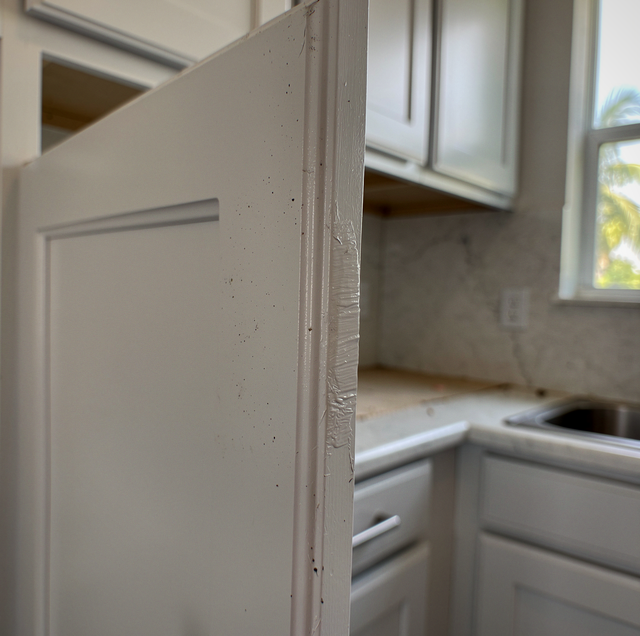
Your kitchen cabinet door used to swing shut with one soft push. Lately it grinds against the frame partway through the arc, and you brace it with your palm before the latch finally catches. A ridge of paint runs along the inside edge, right where the hinge meets the frame, thicker than anywhere else on the panel, and pressing a fingernail into it leaves a small dent that stays.
Nothing about the wood underneath has moved or swollen. The door still hangs true on its hinges and closes flush along three sides. What changed is the space your door swings through, worn narrower with every repaint this kitchen has had, until the gap that once cleared the frame barely lets the panel pass at all.
Why the Gap Between a Cabinet Door and Its Frame Closes
A cabinet door is built with a small reveal running around it, a narrow strip of clearance between the door and the frame it hangs in. That gap lets the door swing freely and gives the two painted surfaces room to sit close together without touching. Paint is not weightless, though. Every full repaint lays another coat on both the door's edge and the frame's rabbet, and each coat uses up a little of that clearance.
One repaint rarely closes the gap enough for you to notice. It is the second, third, and fourth pass, spread across years of ordinary maintenance, that finally use up the room the builder left. By the time a door starts dragging, the cause is almost always that accumulated history, rather than anything wrong with the most recent paint job.
How Many Repaints It Takes Before a Door Starts Rubbing
There is no fixed number of repaints that guarantees trouble, because kitchens are not built with identical reveals and painters do not all lay coats on at the same thickness. A door hung with generous clearance and finished in thin, well-thinned coats can go through several repaints without ever binding, and you may not notice a problem for a decade. A door that started tight, or that picked up one heavy-handed coat along the way, can start rubbing much sooner.
Both cases share the same basic pattern: the paint piles up in the same places. Flat faces get one even pass and level out fine. Corners, edges, and anywhere a brush or roller doubles back pick up two or three passes worth of coating in the time it takes to cover the rest once, and that unevenness eventually turns a wide gap into a tight one.
Painters who repaint the same houses year after year describe it less as a fixed formula and more as a rough rule: a kitchen redone every five or six years can go through three or four full repaints before a door finally complains, and a household that repaints more often gets there sooner. None of that is a promise about your particular kitchen, since a heavier original coat, a tighter original reveal, or one especially thick pass can shorten the timeline by years. What holds steady across every kitchen is the direction: the gap only gets smaller, coat by coat, and it never opens back up on its own.
What Grinds Against What When a Cabinet Door Sticks?
The rubbing happens along one specific line, not across the whole face of the door. The leading edge, the edge nearest the frame on the opening side, is where the door's paint and the frame's paint meet every time the door swings closed. That is the seam where two independently thickened surfaces finally touch, and it is the first place buildup shows up as resistance, not just as thickness you can feel with a finger.
Hinges make it worse from the other direction. Every time the hinge side gets painted without being pulled apart first, coating fills the small hinge mortise a fraction more, and the door's swing shifts slightly closer to the frame on that side too. A door can be dragging at the hinge mortise and the leading edge at the same time, which is why forcing it at the latch rarely fixes anything.
Where the Extra Paint Actually Collects
Whenever hardware gets painted in place without being removed first, the hinge mortise and the screw holes around it collect coating that a clean hinge pocket never would. Multiply that across a few repaints and the hinge side of a door can end up noticeably tighter than the latch side, and you would never guess it just by looking at the face of the door.
The top and bottom corners of a door usually run a close second. A brush changes direction there, and a roller cannot reach cleanly, so a painter goes over the same few square inches twice to get full coverage. Neither habit is a mistake. It is simply where thickness naturally concentrates, repaint after repaint, until the corner nearest the frame is the tightest spot on the whole door.
None of this means a door was painted poorly, then or now. It means the same careful process was repeated often enough, over the years, that ordinary thickness finally caught up with an ordinary gap.
How to Tell Buildup From a Swollen or Warped Door
Run a hand around the whole perimeter of a sticking door and buildup tends to announce itself as an even, all-the-way-around tightness, present in January just as it is in August, because paint thickness does not come and go with the weather. A swollen door usually tells a different story: it drags hardest along the bottom or the side nearest a sink or dishwasher, loosens up again once the air dries out, and shows a slightly soft edge where moisture has gotten into the wood. A warped door adds a visible bow you can sight down the face, a gap that opens on one side while it closes on the other, not an even tightening.
None of these three rule each other out, and a door can have more than one problem at once. A recently painted door is its own case: if it releases with a tacky sound and leaves paint on the frame, the film is still curing. Buildup never comes and goes; a door getting tighter for years, in every season, points at thickness.
Getting the Fit Back Without Sanding Every Door in the Kitchen
The fix that actually resets the clock is having the doors taken off, stripped back to bare material where the paint has piled up, and refinished flat, instead of leaving the buildup in place. Hardware comes off, gets cleaned, and goes back on, not painted over again, which is exactly the habit that concentrates coating in the hinge mortise.
Most European-hinge cabinets can also take a soft-close upgrade at the same time, so the hinges get reset along with the finish. Once a door is back to its original clearance, closing the cabinet just stops being something you think about. It swings shut on its own weight, the latch catches on the first try, and the daily friction of forcing doors that used to be simple goes away.
Ask whether an estimate includes taking every door off its hinges rather than spraying it in place, since the paint causing the rub sits on edges a mounted door keeps permanently hidden.
Frequently Asked Questions
Not on its own. Your door should loosen again once humidity drops, so check it in a dry month before you blame the season. If it still sticks the same way it did before, paint layers on your hinge side are the more likely cause.
It can buy a season, but it planes away wood, not the paint causing the problem, and it does not touch the matching buildup on your frame side. Do that enough times and your door edge gets too thin. A refinish that strips both surfaces gets you a fit that lasts.
Less than you would guess from one coat on your cabinets, which is why it takes years to notice. A repaint might add a hair's width at the door's leading edge. The corners and the hinge mortise take more, because brushes and rollers pool there, and that pooling is where your door starts rubbing.
Sometimes, and only by accident. Many European-style hinges have small adjustment screws that shift your door slightly, and turning them can always buy you a little extra clearance. That is a hinge adjustment, not a cure. Once the layers underneath keep building year after year, the same screws run out of room and your door starts rubbing again.
Often, and sometimes worse. A pantry or closet door gets the same coats as every other cabinet during a whole-kitchen repaint, but it opens less often, and the film along its edge never gets worked loose the way a daily door does. The first time you notice is the day you reach in the back and find your door will not budge.
The paint takes the damage first. Forcing a bound door past the point where it should stop flexes the film at the tight spot until it cracks, and that crack lets moisture reach bare wood, which swells and makes the fit worse the next time you close it. Keep forcing it and the stress moves to your hardware. Hinge screws back out of soft particleboard faster once your door binds on every swing, and your door held by loosening screws drops slightly at the corner, so it catches when paint would not.
Get a sticking cabinet door refinished — every door comes off, the buildup gets stripped from the hinge and edge, and each one is rehung to close the way it did before the first repaint. Vinicio Painting serves Hialeah Gardens, Miami Lakes, Doral. Call (866) 444-1226.
