
Salt air is blamed for wearing out paint the same way heat and rain do, as another source of general weathering. That undersells what is actually going on. Airborne salt is a specific chemical agent that attacks a coating through several distinct physical stages between open water and the point at which a wall visibly fails. Those stages differ by surface, by which side of the building takes the wind, and even by which fasteners happen to be nearby, which is why two walls a few feet apart can age at very different rates.
Quick Answer: Salt air deposits as a dry film that turns to liquid brine when humidity rises, drawing moisture through the coating by osmosis. It also corrodes metal and crystallizes inside masonry, attacking paint from several directions.
Airborne Salt Travels Farther Than the Spray Zone
Wind carries fine sea-salt particles well beyond any point where spray or mist is visible, and those particles continue to settle onto exterior surfaces long after any storm has passed. Wave action and surf break water into tiny droplets that evaporate in the air, leaving behind microscopic salt crystals light enough to ride the wind for long distances before coming back down. That settling process is called dry deposition, and it happens just as much on a clear, breezy day as during a squall.
What lands builds up crystal by crystal in the microscopic pores and texture of a painted surface, and in any hairline crack or pinhole in the film. A wall can look clean and free of spray marks while still carrying a working amount of salt, because the accumulation happens too slowly and too finely to see day-to-day.
The Coating Turns Wet on a Schedule, Not Just After Rain
Dry salt sitting on a painted surface pulls moisture directly out of humid air and forms a concentrated liquid brine once the surrounding humidity exceeds a certain threshold, a process chemists call deliquescence. That threshold sits well within the normal humidity range near open water, so it is routinely crossed overnight and in the early morning hours, with no rain event involved at all.
The practical result is that a salt-coated wall cycles between dry crystal and wet brine on something close to a daily rhythm. Each time humidity climbs, the salt film redissolves into liquid and sits on the surface as a thin, corrosive layer for hours before the air dries out again and the salt recrystallizes. A wall exposed this way spends far more of its life in contact with an active brine layer than a wall that only gets wet when it actually rains.
Regular fresh-water rinsing removes the accumulated dry salt film before rising humidity can turn it back into a corrosive brine layer, which is the real value of washing walls near open water.
How often that rinsing needs to happen depends on how fast a given wall collects salt. A wall that catches regular direct rain gets rinsed on its own, and salt rarely gets the chance to build past a light film. A wall sheltered under an eave or a covered porch, where rain almost never reaches it directly, keeps accumulating salt undisturbed and needs a deliberate rinse on a schedule that matches how fast salt is settling on it, which is faster the closer a wall sits to open water and slower as that distance grows.
Trapped Salt Draws Water Through the Film
Blistering caused by trapped heat or a leak behind the wall is a separate, familiar failure with its own signs, and it happens with or without any salt involved at all. Salt causes a different kind of blister, one driven by chemistry rather than by heat or water pressure pushing from behind.
A paint film, even a good one, has to allow some water vapor to pass through it, or it traps moisture and fails for that reason. What it does not pass through easily is dissolved salt. When salt gets trapped between the coating and the substrate, whether through a pinhole, an edge, a hairline crack, or salt that was already present under an older layer of paint, that trapped pocket becomes a small zone of concentrated brine. The moist air on the outside of the film has a much lower salt concentration, and water moves toward the more concentrated side of a semipermeable barrier the same way it moves into a dried apricot left sitting in a bowl of water. Osmosis draws moisture through the coating toward the salt, and as that water accumulates in the trapped pocket, it inflates the space and domes the film outward into a blister, sometimes with no leak, no direct heat, and no obvious moisture source nearby.
Shaded and Downwind Walls Often Wear Worse Than the Ones Facing the Water
The wall that takes the most direct spray is not always the one that fails first. A windward wall, hit head-on by onshore wind, usually takes on wind-driven rain along with salt, and that rain serves as a periodic rinse that limits how much salt ever builds up.
A wall on the leeward or shaded side of the same building often has no such advantage. It still receives drifting salt aerosol carried around the structure by turbulent airflow, but far less of the rain that would wash it back off, since rain generally follows the wind and the sheltered side gets little of it. That side also dries more slowly, with less direct sun and less air movement across the surface, which stretches the daily window during which any brine layer stays liquid and chemically active. More time wet, combined with salt that never gets rinsed away, adds up to more damage over the same span of time, even though the wall never looks like the one taking the worst of the weather.
Fasteners, Flashing, and Railings Corrode From Within the Coating
Nail heads, screws, hinges, flashing edges, and any exposed steel hardware sit inside a chemically hostile pocket the moment salt reaches them. Dissolved salt dramatically increases the conductivity of a thin surface moisture film, and that conductivity speeds up the electrochemical reactions behind ordinary rusting. Where two different metals touch, such as a steel fastener driven into aluminum flashing, salt-laden moisture turns that contact point into a small galvanic cell, further accelerating corrosion.
A railing, hinge, or fastener showing rust bleed through the paint may be more corroded underneath than the stain suggests. Have it checked before repainting, since a weakened railing or bracket can fail without warning.
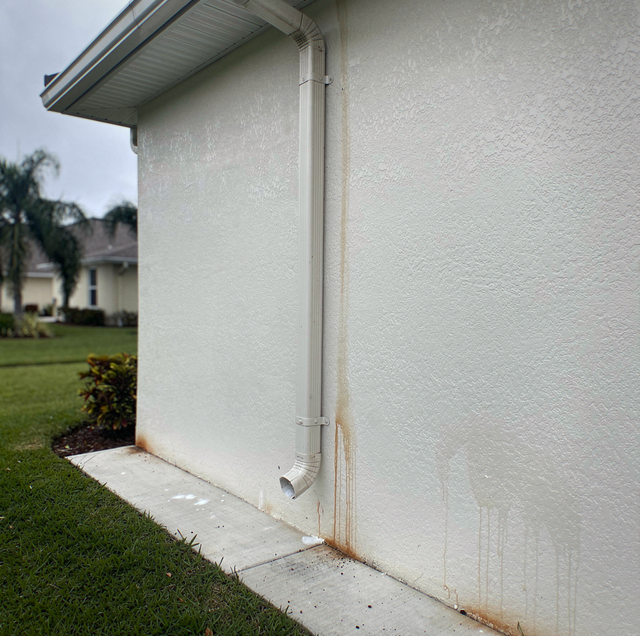
Rust takes up more physical space than the metal it replaces, so as it forms around a fastener head or along a coating edge, it pushes outward and cracks the film from beneath, independent of anything happening with the salt on the surface above it. Rust byproducts are also mobile: they can travel through pinholes and hairline paths in the coating and stain the paint surface a reddish-brown well away from the actual corroding metal, which is why a paint job sometimes gets blamed for a stain whose real source is a piece of hardware corroding out of sight behind or beneath it.
Stucco and Masonry Get Pushed From Underneath
Stucco, block, and concrete carry dissolved salts within their pore structure, some left over from the original mix and more added over time as salt-laden air and rain move through the porous material. Moisture traveling through that substrate carries the dissolved salt toward the surface, and when the moisture evaporates, the salt is left behind as a solid.
Where that crystallization happens right at the surface, it shows up as the familiar white or grey powdery bloom known as efflorescence, which is mostly cosmetic. Where it happens just beneath the surface or underneath a coating instead, it is called subflorescence, and the growing crystals exert real physical force as they form, enough to fracture the paint film and even the outer layer of the substrate itself, pushing the coating off from below. It is a different mechanism from the osmotic blistering described above, driven by crystal growth rather than by water being drawn through the film, but it produces a similar result: a coating that lifts and fails from the inside out.
Specifying a Coating System for Salt Exposure
Every mechanism described above traces back to a decision made before the topcoat ever went on: which primer, how the metal was prepped, and how much the finished coating lets a wall breathe.
- Primer on metal: Bare or previously rusted steel needs a true corrosion-inhibitive primer, not a general-purpose bonding primer, because an ordinary primer does nothing to interrupt the electrochemical reaction happening underneath it.
- Prep on metal: Corroded hardware needs to be mechanically cleaned back to sound, bright metal, not just scuffed, since any rust left trapped under a fresh coat keeps growing and will lift the new film exactly the way it lifted the old one.
- Topcoat permeability on masonry: The coating still needs to let water vapor move outward through stucco, block, or concrete, so trapped moisture and salt have somewhere to go besides the space directly behind the film.
A more impermeable topcoat sounds like the safer choice against salt spray, and on stucco, block, or concrete it is the wrong instinct. Moisture migrating outward through the wall carries dissolved salt with it, and a film that will not pass that vapor forces the salt to crystallize underneath the coating, where crystal growth levers the film off the substrate. Salt trapped under a coating on metal is a different trade-off with a different answer. There, the blister is osmotic, inflated because the film passes water while holding back salt, so a more open film feeds the blister rather than relieving it. The fix in that case is getting the salt off the substrate before the coating goes on, not specifying a more breathable product.
Frequently Asked Questions
Often, yes. What actually determines exposure is a wall's orientation to the prevailing wind that carries the salt, not its compass direction or its straight-line distance from open water. A wall on the inland side of a building can end up taking in more salt than the side facing the water if it sits downwind of a breeze that funnels between structures or around a corner.
Yes, and by a different route. Fog and low cloud droplets form around sea-salt particles as nuclei, and that moisture can carry the salt farther before it settles out than dry wind-blown particles typically travel on their own. A wall miles from open water can still pick up salt-related wear on foggy or misty mornings.
No, and that is the mistake worth avoiding. Salt already worked into stucco pores or trapped under old paint layers stays exactly where it is; a fresh topcoat does not reset it. That embedded salt can blister a brand-new coat faster than expected unless the substrate is washed thoroughly and, in severe cases, treated before the new paint goes on.
Because of which metal ends up sacrificed. In a galvanic pairing, such as a steel fastener against aluminum flashing, salt-laden moisture acts as the electrolyte and the less noble of the two metals corrodes preferentially while the more noble one is temporarily protected. Aluminum is the less noble member of that particular pair, so it is the flashing that gives way first: the metal around the fastener pits and whitens while the fastener itself often still looks sound. The same holds for stainless and galvanized fasteners, since once the zinc coating is spent the aluminum is again the sacrificial one.
No, they are related but not identical. The visible white bloom is efflorescence, salt crystallizing right at the surface, and it is largely cosmetic. Sodium sulfate is one salt conservation scientists point to specifically because it can crystallize in two hydration states with very different volumes, so repeated wet-dry cycling causes those crystals to grow and shrink, and it does the real structural damage underneath.
No. Washing slows the accumulation of new salt on the surface, but it cannot reach salt already trapped beneath the film or incorporated into the substrate. Once blistering has started, the fix is to remove the affected coating, and sometimes to rinse or seal the exposed substrate, rather than relying on more frequent washing to undo it.
Ask about a coastal-grade primer and coating system for your exterior — get a spec built for salt exposure, not just weather. Vinicio Painting serves Hialeah Gardens, Miami Lakes, and Doral. Call (866) 444-1226.