
How Epoxy Floor Coating Actually Holds Up in a Garage
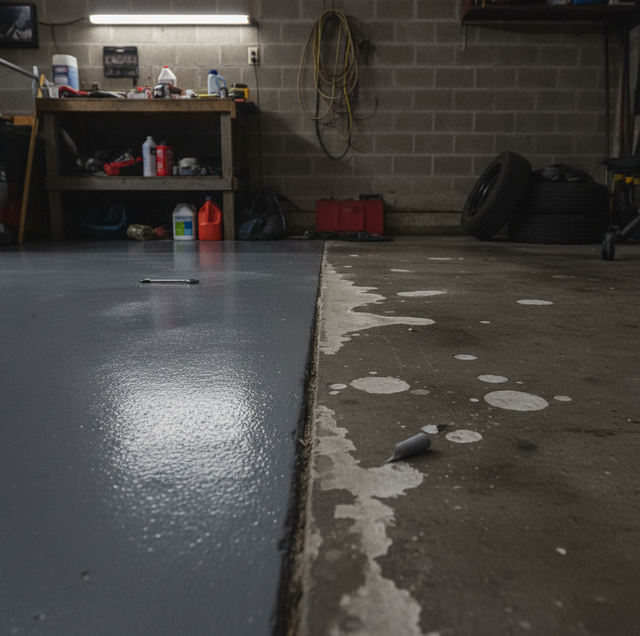
Quick Answer: Epoxy holds up in a garage because it isn't paint, it's a two-part coating that chemically cures into a hard, bonded film that resists abrasion, hot-tire pickup, oil, and moisture. Whether it lasts or peels comes down almost entirely to how the slab was prepped and how dry it was on coating day.
Walk into a garage with a good epoxy floor, and you can feel the difference underfoot before you understand it. The surface is hard, faintly glossy, and it shrugs off the drips and drags that would have stained bare concrete. Walk into a garage where someone rolled on a cheap kit two summers ago, and you'll see the other outcome: gray patches where the coating lifted, bubbles near the door, and a strip peeling up exactly where the car tires sit. Same product category, opposite results. The gap between those two floors is what this article is about.
Why Epoxy Isn't Just Thick Garage Paint
Garage floor paint dries. Epoxy cures. That one difference explains most of how it performs.
Paint is pigment and binder suspended in a solvent or water. When you roll it on, the liquid carrier evaporates and leaves a film sitting on top of the concrete. It's a thin skin, and it stays chemically the same as it was in the can, which is why it scuffs, chalks, and lifts under stress.
Epoxy is a two-part thermoset. You mix a resin with a hardener, and the moment they meet, a chemical reaction kicks off. The two components cross-link into a dense, rigid film that is chemically different from either liquid you started with. It doesn't dry so much as harden into place, bonded to the concrete rather than resting on it. Think of it like the difference between spreading butter on toast and baking eggs into a quiche; one sits on the surface, the other becomes part of the structure.
That cured film is what gives epoxy its toughness. It resists abrasion from foot traffic and dragged toolboxes. It resists oil, brake fluid, and the everyday chemistry of a working garage, because those substances can't easily penetrate a non-porous cured surface. And it resists hot-tire pickup, the failure where warm tires soften a coating and peel it up when the car cools and the rubber releases. A properly cured epoxy is too hard for warm rubber to grab.
The Two Things That Decide Everything: Prep and Moisture
Here's the honest part most product boxes skip. The epoxy chemistry is rarely why a floor fails. Surface preparation and moisture are.
Epoxy bonds mechanically, it grips into the tiny pores and texture of the concrete like roots into soil. If the slab is smooth, sealed, dusty, or greasy, there's nothing for it to grip, and the coating will release later, no matter how good the product was.
That's why prep starts with profiling the concrete. There are two common ways to do it. Acid etching uses a mild acid wash to roughen the surface and open the pores. Diamond grinding uses a machine with abrasive discs to mechanically abrade the top layer off. Grinding is the more reliable of the two: it removes old sealers and contamination that etching can leave behind, and it produces a consistent, predictable profile across the whole floor. Etching can work on a clean, bare, well-drained slab, but it's less forgiving and easy to do unevenly.
Then there's moisture, and this is where a lot of floors quietly doom themselves. Concrete is porous, and a slab in contact with damp ground acts like a wick. Water vapor rises through it and pushes against the underside of any coating; this upward force is often called hydrostatic pressure or vapor drive. Epoxy is largely non-breathable, so if vapor is driving up faster than the bond can resist, it lifts the coating into blisters and bubbles or shears it off entirely. The coating didn't fail because it was weak. It failed because it was fighting water from below.
This matters more on a slab with a high water table and heavy humidity in the air and ground, conditions common on plenty of garage slabs in hot, humid climates, especially those poured close to grade or without a strong vapor barrier underneath. A slab can look bone dry on top and still be pushing vapor.
That's why a real job includes a moisture test before any coating goes down. A common field check is taping a sheet of plastic to the slab for a day or so and looking for condensation underneath, and more precise methods measure the moisture emission or the relative humidity inside the slab. If the numbers are high, the fix isn't to skip the test and hope; it's to use a moisture-mitigation primer or vapor-barrier coating rated to hold that pressure back before the epoxy layers go on.
The Layers That Make a Real System
A garage floor coating that lasts is a system, not a single coat. From the concrete up, a full build usually looks like this:
- Primer: The first coat soaks into the profiled slab and creates the bond. On a moisture-prone floor, this is where a moisture-mitigating primer earns its place.
- Base coat: The main pigmented epoxy layer gives color and is the bulk of the protective film.
- Decorative flakes or quartz (optional): Broadcast into the wet base coat, these vinyl chips or quartz granules add grip and hide minor imperfections, and they let you rinse the floor without seeing every mark.
- Clear topcoat: The sacrificial wear layer that takes the abrasion, the chemical contact, and the sun, so the color coat underneath doesn't have to.
That topcoat choice matters more than people expect, especially where sunlight reaches the floor through an open door or a window. Pure epoxy is known to amber and chalk under direct, sustained UV, a yellowing and dulling that's cosmetic but noticeable. If the sun hits your floor, a UV-stable topcoat, often an aliphatic polyurethane or polyaspartic clear, is the usual answer. It holds color and gloss under light that would slowly discolor bare epoxy. That's a known chemical behavior, not a defect; it's just a reason to specify the correct top layer.
Why Cheap DIY Kits Tend to Fail Early
The kit at the home center and a professional system can both be called "epoxy," and that's where the confusion starts.
Many big-box kits are water-based epoxies with a fairly low percentage of solids, meaning a lot of what you roll on evaporates, leaving a thin film behind. Products marketed as "100% solids" claim that nearly everything in the can stays on the floor as cured material, which is a manufacturer's claim worth reading closely, but the general pattern holds: thinner, water-thinned coatings give you less protective film than a high-solids professional build.
Thin film is the enemy of hot-tire resistance. A thin coating over lightly etched concrete is exactly the combination that lets warm tires soften and lift it. Add in that a DIY job often skips the moisture test, relies on acid etching done by hand, and uses a single-coat approach with no separate topcoat, and you can see why so many kit floors peel at the tire tracks within a couple of seasons. It usually isn't bad luck; it's thin film plus shallow prep plus untested moisture stacking up.
Grip, Slip, and a Wet Garage Floor
A smooth, glossy epoxy floor is beautiful and, when wet, can be surprisingly slick. In a climate where rain blows in through an open garage door, and cars drip water for an hour after a downpour, that's worth planning for.
The fix is a texture built into the coating. An anti-slip aggregate (fine polymer grit, aluminum oxide, or silica sand) is broadcast into or mixed into the topcoat so the finished surface has micro-texture underfoot instead of glass. Decorative flakes add some grip on their own, but a dedicated aggregate in the clear coat is what you ask for if the floor gets wet and you want traction. It's a small addition at coating time and hard to add later, so it's a decision to make up front.
Cure Time and How Long It Lasts
Epoxy is usable in stages. It typically becomes firm enough for careful foot traffic within roughly a day, but it keeps hardening, reaching full chemical cure and full strength takes longer, usually a few days, depending on the product, the temperature, and the humidity. Warmer, drier air tends to speed the reaction along; cool or very humid conditions slow it.
The order that trips people up is vehicle traffic. You can often walk on a floor well before you can park on it, and rolling a heavy car onto a coating that hasn't fully cured is a fast way to leave tire marks or hot-tire damage in an otherwise good floor. The safe move is to follow the specific product's cure schedule for driving, which usually calls for meaningfully longer than the walk-on time.
As for lifespan, an honest answer is that it depends, and anyone quoting you an exact number of years without seeing your slab is guessing. A well-prepped, properly primed, professionally topcoated floor in a home garage can hold up for a long stretch of ordinary use. A thin coating over poorly profiled or damp concrete can fail in a season or two. Traffic matters too: a floor that only sees one family car ages far slower than one under a truck, a welding cart, and equipment that is constantly being dragged. Prep and traffic, not the label, set the real timeline.
Frequently Asked Questions
There's no fixed number, and it depends on two things more than any other: how the slab was prepared and how hard the floor gets used. A professionally ground, primed, and topcoated floor in a light-use home garage can go many years before it needs a fresh topcoat rather than a full redo. The wear layer is designed to be renewable; often, you can scuff-sand and recoat the clear layer to reset the surface without stripping the whole system, which considerably extends the life of the color coat underneath.
Not without dealing with what's already down. Epoxy has to bond to the concrete or to a sound, compatible layer, and a floor that was painted, sealed, or coated before is a question mark. If that old layer is loose, glossy, or a sealer that keeps anything from soaking in, the fresh epoxy grabs the old coating instead of the slab and eventually lifts with it. The honest path is to test adhesion and, in most cases, grind the old finish off to reach clean, open concrete, since a sealer in particular has to come off for anything to bite. Coating over a mystery layer someone else applied is a gamble, which is why a pro identifies what's there before deciding on prep.
Almost always one of two causes: a bond that never formed, or moisture pushing from below. If the concrete was smooth, sealed, dusty, or greasy when it was coated, the epoxy had nothing to grip and released later. If the slab was passing water vapor upward, that pressure lifts the coating into blisters or shears it off in sheets. Peeling concentrated at the tire tracks points to hot-tire pickup on a coating that was too thin or not fully cured. The pattern of the failure usually tells you which one you had.
There are real tests, and skipping them is where floors fail. The quick do-it-yourself version is taping a couple of feet of plastic sheet tightly to the bare slab for a day or two: moisture beading on the underside, or a darkened patch of concrete, means vapor is pushing up. Installers go further with a calcium chloride kit that measures how much moisture the slab gives off over 24 hours, or a relative-humidity probe set into a drilled hole to read conditions from inside the concrete. Signs you can spot without any kit include white powdery efflorescence, damp-looking low spots, and old floor tile that curled or let go, each one a hint that the slab drives moisture and needs a mitigation primer rather than just a coat of epoxy.
A lot, because epoxy cures by a chemical reaction rather than by drying, and reactions speed up in heat and stall in cold. Applied too cold, the coating can stay soft or never reach full hardness; applied in a hot, humid stretch, the mixed epoxy sets faster in the bucket and cuts your working time, and moisture in the air can leave a hazy, greasy-feeling film called amine blush on the surface. A slab that is colder than the humid air above it can even sweat condensation partway through the job and ruin the bond. That is why installers watch the slab temperature and the dew point, not just the day on the calendar, and why a rushed coat on the wrong day fails even with good product.
Upkeep is light, which is part of the appeal, but a few habits matter. Sweep or dust-mop grit regularly, since sand ground underfoot or under a tire is what actually abrades a hard coating over time. For washing, warm water and a mild cleaner handle most of it; skip harsh, acidic, or solvent cleaners that can dull or attack the topcoat. Wipe oil, brake fluid, and battery acid promptly instead of letting them sit, and set a mat under a motorcycle kickstand or a jack stand so a small point load doesn't dent the film. If the clear topcoat ever looks worn in the tire paths, that layer can usually be scuffed and recoated before the color coat is ever exposed, which is how a well-built floor gets stretched into many years of service.
Schedule a slab moisture check and coating consultation — so your garage floor is prepped to last, not just painted to look good. Vinicio Painting serves Hialeah Gardens, Miami Lakes, and Doral. Call (866) 444-1226.
