
How Venetian Plaster Gets That Polished-Stone Look
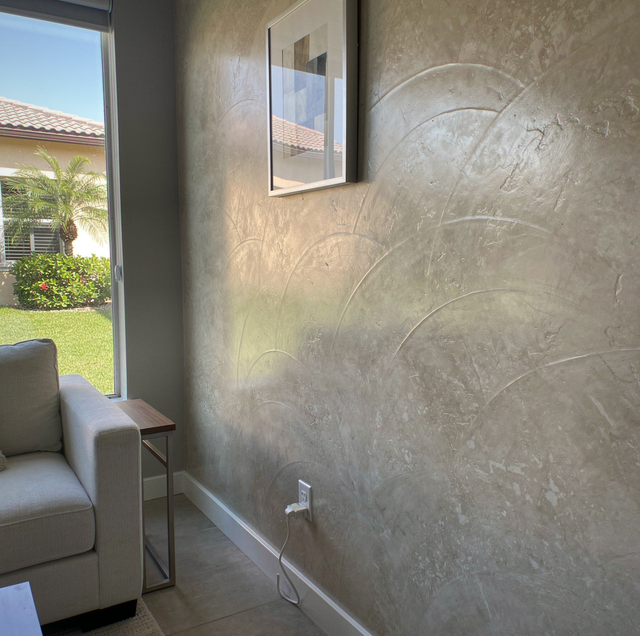
Run your palm across a finished Venetian plaster wall, and it feels almost like touching cool stone: smooth in spots, faintly ridged in others, with a soft glow that shifts as you move past it. No roller or paintbrush produces that effect. It comes from a completely different application method, built up in thin layers by hand, and from materials that behave nothing like paint once they're on the wall.
What Venetian Plaster Actually Is
Traditional Venetian plaster starts with lime putty, made from burned limestone that's slaked with water and aged for months or even years, then mixed with finely ground marble or limestone dust. That combination gives the finish its name and its distinctive light-catching quality: the marble dust reflects light the way stone does, rather than absorbing it flat the way pigment in ordinary paint does.
Most of what's sold today as Venetian plaster or faux plaster for residential walls is a modern reformulation, based on an acrylic or vinyl binder rather than lime putty. These acrylic versions are far easier to work with, don't require the aging and curing that true lime plaster does, and come pre-tinted in a much wider color range, but they get their sheen and depth from added mica or metallic particles rather than from marble dust and light passing through true lime layers.
The Layering and Troweling Technique That Creates Depth
Whichever material is used, the application method is what actually produces the finish. Plaster goes on in two to three separate thin coats, applied with a flexible stainless steel trowel held at a shallow angle to the wall, working in overlapping arcs rather than long, flat strokes. Each coat is applied before the previous one fully sets, so the layers bond together into a single continuous mass rather than sitting as separate films, as multiple coats of paint would.
That layering is what creates the marbled depth. Because each thin coat carries slight variation in how it's troweled on, light entering the surface passes through several translucent layers before reflecting out, picking up subtle shifts in tone and shadow along the way. A single flat coat of the same material, applied like paint, produces a matte, uniform surface with none of that visual depth.
Why True Lime Plaster Hardens Into Stone
True lime plaster doesn't dry the way paint or acrylic plaster does. It hardens through a chemical reaction called carbonation: as the wet lime putty is exposed to air, it slowly absorbs carbon dioxide and converts back into calcium carbonate, essentially reforming into the same mineral limestone was made of in the first place. That process can take weeks to fully complete, which is part of why old lime-plastered walls in historic buildings have held up for centuries; the surface is chemically closer to stone than to a coating sitting on top of a wall.
Acrylic-based faux plaster doesn't carbonate. It cures the way any acrylic coating does: by water evaporating from the binder, which is faster and more predictable, but it never reaches the same rock-hard, stone-like surface that true lime plaster develops over time.
Burnishing, Wax, and Keeping the Finish Protected
The final step for most Venetian plaster finishes is burnishing: compressing and polishing the surface with the flat edge of a trowel, or a dedicated burnishing tool, while the top layer is still workable. This compacts the surface particles and brings out the sheen, much like polishing compacted stone brings out its shine.
Traditional lime plaster is typically sealed with a thin coat of beeswax paste, buffed in by hand, which deepens the color, adds a soft luster, and gives some protection against moisture and staining. Wax finishes need occasional reapplication and rebuffing, usually every few years in a well-used room, since the wax layer wears down with contact and cleaning. Acrylic faux plaster is more often sealed with a clear acrylic topcoat rather than wax, which holds up better to moisture without maintenance but reads slightly flatter and less luminous than a waxed lime finish.
Tools That Shape the Finished Texture
The trowel itself changes the outcome as much as the plaster does. A wider, more flexible Venetian trowel with rounded corners lays down broader, softer arcs and tends to produce a smoother, more uniform look, while a smaller, stiffer trowel leaves tighter, more defined strokes that read as a more rustic, hand-tooled texture. Some finishes also use a separate burnishing blade, thinner and more flexible than the application trowel, specifically for the final polishing pass, since a stiffer tool can drag and scar a surface that's already begun to set.
Where Venetian Plaster Works Best
Plaster is far less flexible than a paint film once it's cured, so it doesn't tolerate a moving or unstable substrate well. A wall with active settling cracks, or drywall seams that haven't fully stabilized, can telegraph hairline cracks through a plaster finish within a year, even though the same movement would barely show under paint. That makes plaster a better fit for a stable accent wall or a feature surface than for an entire house, and it needs a properly primed, skim-coated substrate underneath rather than bare drywall or old wallpaper.
Common Mistakes That Flatten the Effect
The most common mistake is applying each coat too thick, which defeats the layering effect entirely: a heavy, single-pass application dries as a single opaque skim coat rather than several thin, semi-translucent layers, so the wall ends up looking like ordinary skim-coated drywall with a slight sheen rather than true depth. Applying plaster in direct, hot sunlight through a window can flash-dry the surface before it's properly troweled and burnished, leaving visible trowel-stop lines instead of one continuous blended surface.
Inconsistent trowel pressure is another frequent issue: pressing hard on some passes and lightly on others changes how much material each stroke leaves behind, so the tonal variation that should look intentional instead reads as patchy or streaky. Rushing the interval between coats, without letting the previous layer reach the right partial-set stage before the next one goes on, keeps the layers from bonding into a single continuous mass, and that shortcut can show up months later as lifting or fine cracking along the coat lines.
How Lighting Changes the Way a Finished Wall Reads
The same Venetian plaster wall can look noticeably different depending on the light falling on it, more so than a painted wall does. Warm incandescent or LED lighting tends to bring out the amber and gold tones in the marble dust or mica, while daylight from a north-facing window reads cooler and flatter on the same surface. The direction of the trowel strokes matters too: light raking across the wall at an angle catches the ridges left by each overlapping arc and makes the depth far more visible than the same wall lit straight-on from overhead, which is why a sample board tested only under one light source in a showroom can look surprisingly different once it's on the actual wall at home.
Frequently Asked Questions
A single accent wall typically takes two to three full working days from first coat through burnishing and sealing, since each layer needs time to set before the next goes on, compared to a day or less for the same wall in ordinary paint.
Yes, but the paint needs to be scuffed or lightly sanded first so the plaster has enough texture to grip, and glossy paint sheens usually need a bonding primer coat first since plaster won't adhere reliably to a slick surface on its own.
Unlike a paint touch-up, repairing a scratch usually means reworking an entire trowel pass across that section, blending new plaster into the surrounding area at the same angle and pressure, since a small dab of plaster applied differently from the rest will show as a mismatched patch.
A properly sealed finish, especially one with an acrylic topcoat rather than wax alone, can handle normal bathroom humidity, but it isn't recommended for direct, constant water contact, such as inside a shower enclosure, where tile or a specialty waterproof coating is the better choice.
Two to three closely related tones are typical, applied in separate coats so each layer shows through the next, which is what produces the subtle color movement across the wall rather than one flat color.
No, finished Venetian plaster typically builds up to only about one-eighth of an inch or less across all coats combined, thinner than most heavy-texture finishes, since the depth comes from translucent layering and troweling rather than from physical thickness.
Venetian plaster rewards patience more than almost any other wall finish, since the depth people notice from across the room is really the sum of several thin layers, each applied and burnished before the next. Done properly, on a wall that's stable enough to hold it, it's a finish that ages by developing more character rather than by wearing out.
Ask about Venetian and faux plaster finishes for your next room — a stable accent wall with real depth. Vinicio Painting serves Hialeah Gardens, Miami Lakes, and Doral. Call (866) 444-1226.
