
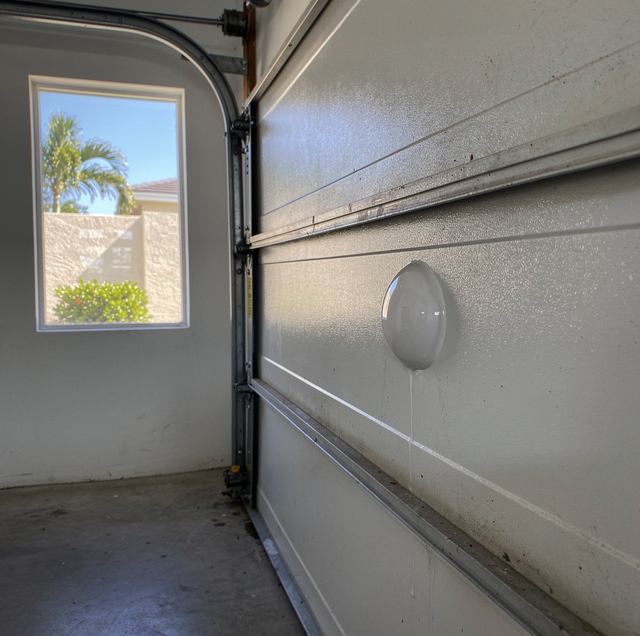
A blister in the paint on a metal garage door is easy to notice and easy to misread. It looks like a coating problem, so the tempting fix is to strip the door and start over. What is happening underneath the raised paint is a different question every time: sometimes it is trapped moisture, sometimes it is rust that started before the last coat ever went on, sometimes it is heat from direct sun working on the coat while it was still curing, and sometimes the new coat never bonded to the finish under it. The right repair depends on which of those is true for that door, on that panel, right now.
What a blister looks like on the outside points to what is happening under the paint film:
| What You See | What's Underneath |
|---|---|
| Water-filled blisters | Moisture trapped behind the film — condensation, a slow leak, or humidity with no way to escape |
| Dry blisters that appear in the first day or two after painting, in hot weather | Trapped solvent or vapor from painting a hot surface, not a leak |
| Blisters with rust visible once popped | Corrosion already working under the coating, starting at a chip or scratch the old finish never fully sealed |
| Bubbling along panel edges or the bottom section | Water sitting longest at seams, weatherstrip, and low edges, working in from there |
| Blisters only on the sun-facing side of the door | Surface heat from direct sun driving the blister, not moisture |
What Makes Paint Lift off a Metal Garage Door
Four things push paint off a steel or galvanized door, and a single blister can have more than one of them working under it.
Moisture trapped behind the film is the first cause. A door that sits on the shaded side of the house can hold condensation overnight on its cool metal surface longer than one that dries out quickly in the open sun, and that trapped film of water works against the coating from behind until it lifts.
Rust already working under an old finish is the second. A chip, a deep scratch from a bike pedal or a car mirror, or a spot where the factory coating never fully sealed gives corrosion a starting point. Once rust begins under the film, every wetting feeds it, and a fresh coat applied on top seals the corrosion in without stopping it.
Painting a hot surface sets off a separate failure mode, one with no moisture involved at all. A dark steel panel in direct sun can reach a surface temperature that the coating's stated application range never anticipated, and the outer skin of a fresh coat sets before the solvent beneath it finishes evaporating. With no path outward, that trapped vapor pushes upward and domes the still-soft film into a blister within a short window after the brush or roller leaves the surface.
The fourth cause sits in the primer, not the topcoat. A garage door's factory finish is baked on at the plant, and a repaint that skips scuffing that gloss or skips a bonding primer can fail to get a true grip on it. Galvanized steel adds its own wrinkle: the zinc coating that protects the steel underneath resists ordinary primers, and a topcoat applied without a primer designed to bond to zinc can lift in whole sheets rather than the small dome pattern moisture and heat leave behind.
Reading What's Under a Blister
A blister does not have to be popped to tell you something. Where it sits and when it appeared both help pin down the cause. A hard, brittle dome points to trapped vapor from a hot-surface application, or to rust pushing up from underneath.
Once a painting crew has tested an older finish for lead, opening a small blister reveals what is underneath: a dry, reddish-brown surface points to rust, and a wet surface points to moisture. Neither reading settles the cause on its own, and where the blister sits on the door narrows the cause further. Blisters clustered at a panel seam or along the bottom section point toward water working in from an edge. Blisters scattered across the flat field of a panel, away from any seam, point more toward a surface or application problem than an edge intrusion.
Timing helps too. A blister that shows up within the same week as a repaint is telling you something about that paint job specifically — heat during application or a coat applied before the surface had a chance to dry. A blister that appears years after a repaint is telling you the coating held for a while before something underneath it changed: rust that had time to start, or a leak that developed later.
The Repair: Scrape, Treat Rust, Prime for the Metal, Repaint
Once you know what is under the blister, the repair follows a set order, and skipping a step here is how a garage door repaint ends up failing again.
Scraping or sanding a door's paint releases dust, and old paint may contain lead. Have a painting crew test an older, untested finish before any blister is opened or scraped, and leave chemical stripping to that crew, not a shelf product.
Scrape every blister back past its edge into paint that is still firmly bonded, not just the domed section itself. A blister that is scraped only at its highest point leaves a ring of loosely attached paint around the repair, and that ring can lift again on its own.
Any rust exposed underneath gets treated before anything else touches it. Where a grinder or sander can reach, rust comes off to bright metal; in the corners of raised ribs, around hinges and along rolled edges that a tool cannot fully reach, a rust-converting primer treats what remains.
Before any primer goes on, the door also gets a full rinse: any cleaner or degreaser residue left behind by washing the door prevents a new coat from bonding, as does loose chalk or dust. From there, the primer has to match the substrate, not just the topcoat color. Bare steel takes a rust-inhibitive metal primer. A factory-finished panel that is still sound but glossy needs its surface scuffed enough for a new coat to key into it, since paint laid directly over an untouched gloss is one cause of a fresh repaint peeling. A galvanized panel needs a primer made to bond to zinc rather than a general steel primer, because zinc's surface chemistry does not accept an ordinary primer the way bare or painted steel does.
Once the surface is prepared, the topcoat goes on as two coats of a paint rated for exterior metal, not one heavy coat. A single thick coat cures unevenly through its depth, giving trapped vapor time to work beneath the film before the coat fully sets; two thinner coats cure more evenly and provide the same protection.
Painting a Garage Door Without Gluing It Shut
A sectional door has hinged joints between its sections, and those joints must remain free. Paint is laid into each joint with the door closed and brushed out so it does not bridge the gap. Once the coat is dry to the touch, the door is run open a short way and back so any film across a joint breaks cleanly rather than tearing off in a strip later. The weatherstrip along the bottom and the rubber seal at the jambs are masked rather than painted because paint on rubber can crack as the seal flexes, leaving a flaking edge at the exact spot where water collects.
When the Door Needs More than Paint
A repaint solves a surface problem. Some blisters are pointing at a structural one underneath.
Rust that has eaten through the full thickness of the steel, leaving a hole or a soft, crumbling edge you can push a fingernail into, is past what a rust converter and a patch of filler can fix. At that point the panel itself needs replacing, not just its finish.
A dent that has cracked or stretched the paint film at its edges can keep cracking at that line on a door that is otherwise well prepped, because the deformed metal flexes differently than the surrounding panel every time the door moves or the temperature changes. A shallow dent can sometimes be filled and faired before painting; a dent that has visibly stretched or torn the metal is not a paint fix.
Either situation calls for checking the door before more paint goes on. Whether the answer is a repaint or a panel replacement, a new finish holds only on sound metal underneath it.
Where the door sits also changes how wide the repaint goes. Near the coast, salt air is hard on a door's finish, so a blistered door there is judged for a full repaint of the affected panels rather than a round of spot repairs. Farther inland, where that wear remains slight, an isolated blister on an otherwise sound panel is judged to be a spot repair.
Frequently Asked Questions
Scratch a hidden edge, such as the inside of the bottom panel. Bright, silvery-gray metal under the paint is the zinc galvanizing; the dull gray metal that can show rust soon after exposure is bare steel underneath the old finish.
A dark panel's surface in direct sun can run 40°F or more above the air temperature, so it can pass the highest surface temperature listed on the paint's label on a day that does not feel especially hot to a person standing next to it.
No. Whatever is pushing the blister up, whether trapped vapor, moisture, or rust, stays trapped underneath, and the new coat over it can blister again in the same spot. Every blister gets opened, dried or descaled, and treated before the new coat goes on.
Only where rust has reached it. On a single-layer steel door, the back of the same sheet is the inside face, and any rust spot there receives the same scrape, rust treatment, and primer from the inside; the sound, factory-finished inside face is left alone.
Because they are following the building's own shadow rather than the paint itself. A blister pattern that ends abruptly at the edge of the shade cast by a nearby wall, tree, or fence points to surface heat as the cause, while a moisture-driven blister ignores the shadow line and can appear on the shaded side just the same.
No. The zinc on galvanized steel reacts with the oils in alkyd paint, breaking down the binder where the two meet, so the coat loses its grip on the metal. An acrylic exterior paint contains no oil binder for the zinc to attack, which is why an acrylic topcoat is preferred over galvanized metal.
Choose garage-door restoration for a blistered steel door — blisters opened and scraped back, rust treated, a primer matched to steel or galvanized metal, and two exterior coats. Vinicio Painting serves Hialeah Gardens, Miami Lakes, Doral. Call (866) 444-1226.